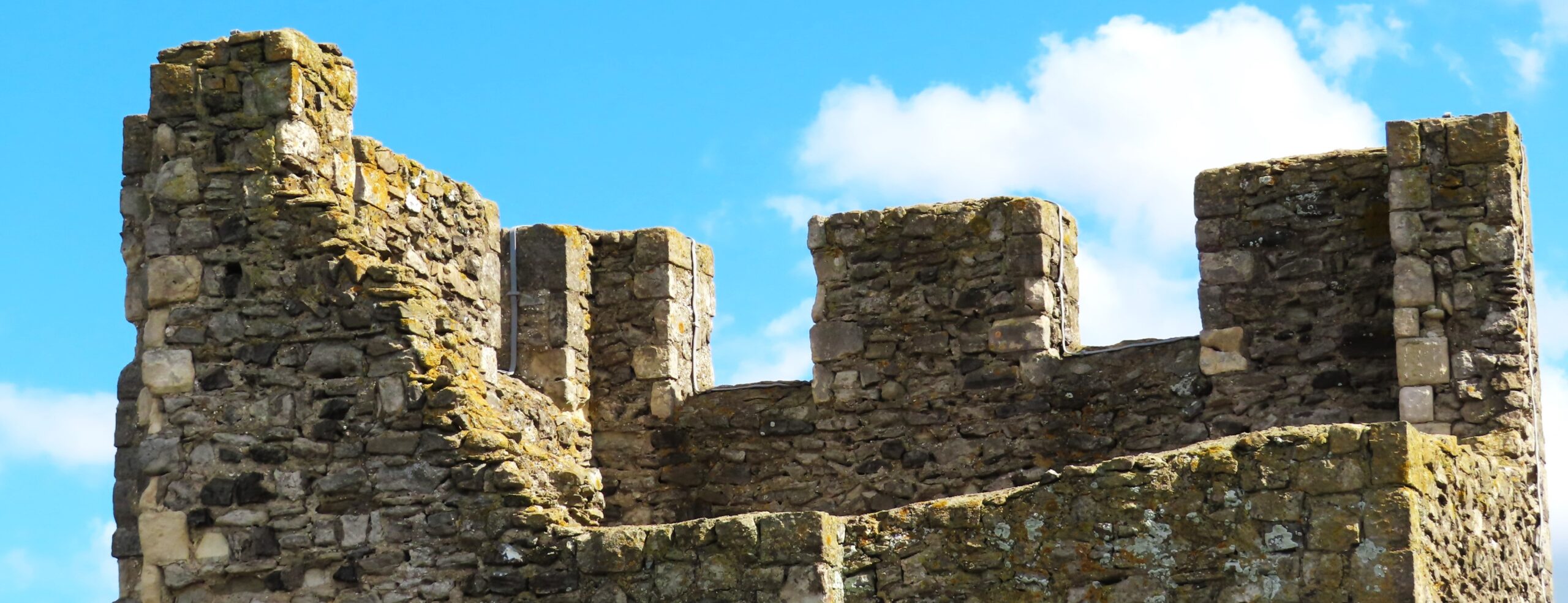
If you’re looking for a historical trip from London, a day trip to Rochester is a perfect option. You can easily get there and back in a day with enough time to thoroughly explore what the medieval city has to offer.
Why should you do a day trip to Rochester?
Rochester is close to London and, in my opinion, one of the most interesting historical cities around.
Rochester was originally a Roman settlement. The historic Watling Street, a key Roman road, runs right through Rochester.
Rochester’s prevalence continued into the Anglo-Saxon period and is the location of the first written record of a legal system in England, preserved in a book in Rochester Cathedral.
Throughout the medieval period, Rochester’s cathedral and castle contributed to it becoming an important town. This importance was compounded by its location on the River Medway which is the main gateway to the River Thames and thus where any ships hoping to invade London would arrive.

The river remained an important feature of Rochester beyond the medieval period. The dockyard at Chatham, a mile away from Rochester, was established in the sixteenth century and formed the origins of the Royal Navy.
How to get to Rochester from London
It’s very easy to do a day trip to Rochester from London. Rochester is about 30 miles south east of London and you can get a direct train there from Victoria, London Bridge or St Pancras Stations. The fastest trains will get you there in a little over half an hour.
So now, what should you do in Rochester?
Rochester Cathedral
Rochester Cathedral is an important part of the town, both in terms of its physical presence there and in terms of its long history. I would suggest starting there.
There has been a religious establishment on the site of Rochester Cathedral since the seventh century but the first building works on the present cathedral were in 1080. Over the following centuries, it was expanded and remodelled, but it was then left to fall into disrepair after the Dissolution of the Monasteries in the sixteenth century. Since the mid-seventeenth century onwards, it has been slowly restored. Even still today, building or repair works uncover parts of the old foundations of the original cathedral.
In the cathedral, keep an eye out for these key features.
Wheel of Fortune fresco
The Wheel of Fortune fresco in Rochester Cathedral depicts the medieval moral principle that fortune can shift any moment, and that to some extent you are always beholden to fate and fortune, or good luck and bad luck.
Half of the painting in the cathedral was unfortunately destroyed during the Reformation. However, luckily for us, the remaining half was concealed behind an item of furniture and therefore survived.
The painting depicts a wooden wheel under Queen Fortune’s control. People sit at various points of the wheel, and Fortune turns the wheel at her discretion. Even the man at the top of the wheel, who is supposedly the most fortunate in that moment, looks apprehensive because he may be aware that the next turn of the wheel might cause him to cascade down to the bottom of the wheel where his fortune is at its lowest.

The idea of the Wheel of Fortune was a popular trope in the medieval period, not only in England but further afield, and it appeared in other artistic formats as well as paintings. For example, a French composer, Guillaume de Machaut, wrote a sort of moralistic fourteenth-century musical on the subject: his Remède de Fortune which is a secular work. I had learnt about this work at university and I found it interesting to see that the tale was also prevalent here in a religious setting.
Ancient books in the crypt
Like many old cathedrals, Rochester Cathedral has always had a library. Unfortunately, over the years, many of its books have been lost or destroyed.
However, one monumental book that has remained at Rochester Cathedral is the Textus Roffensis. This is essentially the oldest written record of Anglo-Saxon law. The book dates from the 1120s but it records laws records spanning from around the year 600 to around the eleventh century. It certainly covers aspects of the reformed laws established by King William I after his conquest of England in 1066.
The crypt also has an exhibition about life in the medieval monastic community which is worth a browse.
Like many of England’s cathedrals, Rochester Cathedral’s crypt also has a café so this is an option for lunch if your timing works out.
Cloisters
Outside the cathedral, you will find the cloisters. This area encloses the rooms the monks would have used for their daily living, including their dormitory and their refectory. The cloisters date from the early twelfth century.
Rochester Castle
I’ve mentioned above that Rochester sits at the mouth of the River Medway and was an important medieval lookout point for enemies trying to sneak in up the River Thames. I would suggest that the next stop of your day trip to Rochester should be Rochester Castle which was the main lookout point for any such enemies.

Rochester Castle was built in the early twelfth century. Its main feature is a square keep which originally had a square tower at the top of each corner. Outer walls surround the keep and now enclose the castle green.
Rochester Castle’s big moment was in 1215 when King John besieged it. He managed to destroy one of the upper square towers, which was later rebuilt in a circular shape which remains today. Although the inhabitants of the castle valiantly resisted his siege for two months, they eventually succumbed due to starvation.
The castle green has some information boards with useful illustrations depicting what the castle would have looked like before and after the siege. These are well worth a read as they give interesting context to the castle structure you can see today.
Rochester Castle is an English Heritage site so it’s free to enter if you’re a member.
The River Medway
Finally, given how much of a feature the River Medway is in Rochester, take a short stroll down the coast path. You can get straight onto the coast path from the castle by crossing the castle green.
Find a bench on the Esplanade and watch the boats. Even after hundreds of years, the River Medway is still a busy area for them.

Other historical day trips from London
If you like the sound of this day trip to Rochester, and if you’re keen on ancient castles and churches and looking for more day trips from London with a similar vibe, consider:
- Cambridge
Home to an 800-year-old university and full of old chapels, churches and libraries.
- St Albans
An important Roman settlement where Roman ruins are still part of the fabric of the city.
- Norwich
An Anglo-Saxon city packed with medieval buildings, and also a UNESCO Creative City of Literature.
- Canterbury
Site of a world-famous cathedral and location of the murder of Thomas Becket in 1170.
Leave a Reply