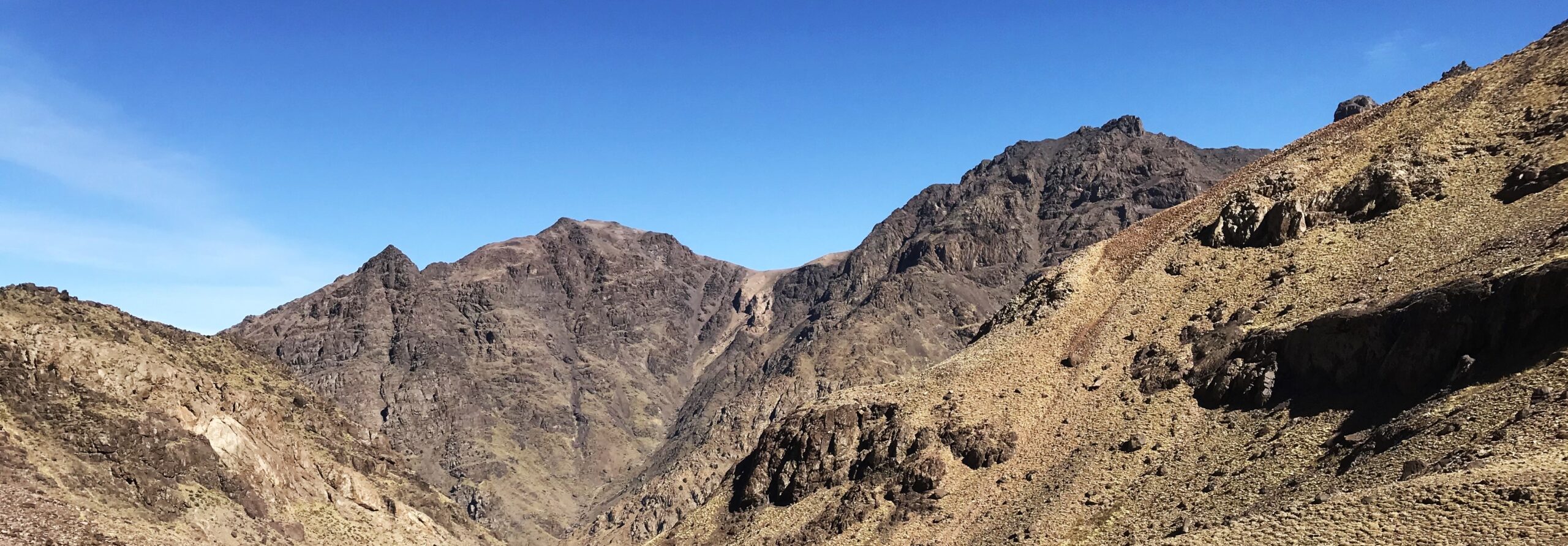
Is there a more satisfying feeling than the euphoria of summiting a mountain? Here’s my experience of trekking Mount Toubkal in Morocco, and some tips to smooth the figurative steep mountain path.
About Mount Toubkal
Mount Toubkal is North Africa’s highest peak, standing at 4,167 metres (13,671 feet). It’s in Morocco’s Atlas Mountains, sitting to the south of Marrakesh.
Do you have to have a guide to trek Mount Toubkal?
Since late 2018, it has been mandatory to hire a guide to trek Mount Toubkal. This rule resulted from the shocking murders of two Scandinavian tourists in their tents in the Atlas Mountains.
Having a guide is a safety measure – not to mention that the guides know the mountains like the back of their hand. Our guide told us he climbs Mount Toubkal a staggering 300 times a year!
Getting to Toubkal base camp from Marrakesh
The easiest way to hire a guide and get to Mount Toubkal is to book a tour. This way, you sort your transport and your guide in one go.
I signed up for a three-day GetYourGuide tour from Marrakesh, with all meals and accommodation included. I was with a friend and we thought we were joining a group but it turned out just to be us and our guide!
On the first day of our tour, a driver collected us from Marrakesh and took us to the village of Imlil in the Atlas Mountains. We met our guide and he took us for a practice trek for a couple of hours. I assumed this was to gauge our ability and speed for trekking Mount Toubkal in full.

We stayed at someone’s house in Imlil and slept under warm, woollen blankets. Imlil is 1,800 metres above sea level which helps you acclimatise to the altitudes you’ll experience when trekking Mount Toubkal.
On the second day, we trekked from Imlil to the Refuge du Toubkal, which functions as Mount Toubkal’s base camp. The route took us through the rocky scenes of Toubkal National Park under the deepest of blue skies.
Toubkal base camp and starry nights
The Refuge du Toubkal is large and basic. The dormitory we stayed in was vast, with three-level bunk beds collectively occupied by about 50 or 60 people. It’s safe to say I didn’t get the best night’s sleep, especially as we were up at 4am to start the trek to the summit for sunrise.
As is common with mountain refuges, you are given an evening meal and breakfast. There was no hot water and no electricity.
But the lack of electricity was a blessing in disguise. It meant that there was such complete darkness that the sky was bursting with stars. We stood outside the refuge looking down a mountain valley; above us, the Milky Way streaked across the sky in perfect alignment with the valley. Shooting stars darted between constellations, sparking a beat of excitement every time.
I’ve seen some pretty great night skies on my travels, including in the Atacama Desert which is reportedly the best place in the world for stargazing. But, in my experience, the stars in the Atlas Mountains still top the rankings for the clearest and most abundant I have ever seen in my life.
Up to the summit of Mount Toubkal
You won’t be thinking of the stars as your alarm goes off well before dawn the next morning.
The trek to the summit of Mount Toubkal is challenging. It’s rocky, with no clear path. Our guide led us in zigzags because the ascent was so steep. It was freezing cold. Quite honestly, it felt endless and I wonder if that was because we could see neither how far there was to go nor how far we had come because it was pitch dark!
As the sky lightened to the creeping greyness of pre-dawn, we had our first glimpse of the summit. It didn’t seem so far off! We pressed on and we reached the summit just as the sun broke over the horizon.
It’s impossible for me to put into words how incredible it was to stand on top of the world around me after such a climb. Mountain peaks surrounded us, all lower than the one we were standing on. All of them were tinged a soft orange by the early morning sunlight. I’m not ashamed to say that I cried because it was so beautiful. Maybe the altitude did addle my brains a bit after all.

And down again
I got a grand total of two photos at the peak of Mount Toubkal – it was so cold that my phone battery died almost immediately after taking the second photo. Our guide was ready to prepare tea for us but after only a short while at the summit we were too cold to stand still and we wanted to descend.
I was exhausted by this point and it took all my energy to focus on putting one foot in front of the other to return safely to the Refuge. It was a relief to sit down for a rest there before continuing the journey back to Imlil.
After a long day of trekking, a driver collected us from Imlil and took us back to Marrakesh.
Do you have to be at peak fitness to trek Mount Toubkal?
There’s no denying that trekking Mount Toubkal is HARD. So it’s certainly helpful – and safer for you and anyone trekking with you – to be at a good fitness level to do the trek. We saw several people giving up and heading back down the mountain when we were climbing up, so this trek really isn’t something that just anyone could do.

That said, when I think about what was hardest thing about trekking Mount Toubkal, it’s not the physical fitness aspect. It was the altitude and the cold. When you’re at altitude (ie above 3,000 metres) the air is thinner, and the reduced amount of oxygen in it makes you feel breathless. Our guide said that the amount of oxygen in the air on the trek up Mount Toubkal is about 60% of what you’re normally used to. Because of the breathlessness you’ll feel, your brain tricks you into thinking you’re unfit.
Luckily I didn’t suffer from altitude sickness but my friend did. Somehow she managed to trek to the summit feeling sick with a pounding headache – a real trouper! If you can find a way to spend more time acclimatising to the altitude when you’re planning your trip to Mount Toubkal then I recommend you do that.
In short though, ignoring altitude sickness, better fitness generally means a better ability to cope with the altitude. So you have nothing to lose by doing a bit of training before trekking Mount Toubkal.

The weather
I’ve mentioned the cold as well but this depends on the season. I trekked Mount Toubkal in early November and it was so cold that my water froze in the bottle. The fact that I was struggling to drink anything contributed to the difficulty of the trek!
However, when the sun was out, it was dry and clear (although I still wore thermals). If you trek Mount Toubkal any further into the winter, you’ll encounter snow and you may need specialist snow-trekking kit. On the flipside, doing the trek in June or July might be unbearably hot.
So this is your reminder to check the weather before trekking Mount Toubkal and to dress accordingly.
What to bring for trekking Mount Toubkal
I recommend packing light as you’ll be carrying your backpack a long way. However, I think the following items are essential for trekking Mount Toubkal:
- Walking boots
It goes without saying that trainers are insufficient.
- Thermals/fleece/layers and warm jacket
Depending on the time of year, it can be extremely cold out in the Atlas Mountains, especially when it’s dark!
- Specialist snow-trekking kit
This depends on the season, but you won’t want to be without specialist kit if you need it.
- Sunglasses and suncream
The sun shines strongly at altitude so be prepared with sunglasses and suncream.
- Headtorch
You’ll need a headtorch when you’re climbing up Mount Toubkal in the dark. It’ll also be useful for making your way around the Refuge in the evening as there’s no electricity.
- Portable charger
On a similar note, make sure you can charge your phone without access to electricity.
- Lots of water
There are limited places to buy or top up your water along the way.
If you’re sticking around in Morocco, check out my nine days in Morocco itinerary.
Leave a Reply