I had high expectations of Cape Town. But I didn’t realise it had so much depth. It’s such a varied city, both in terms of what you can physically see and also in its historical and cultural subtleties. Here are seven things I think you should know before visiting Cape Town.
1. Cape Town’s nature is unreal
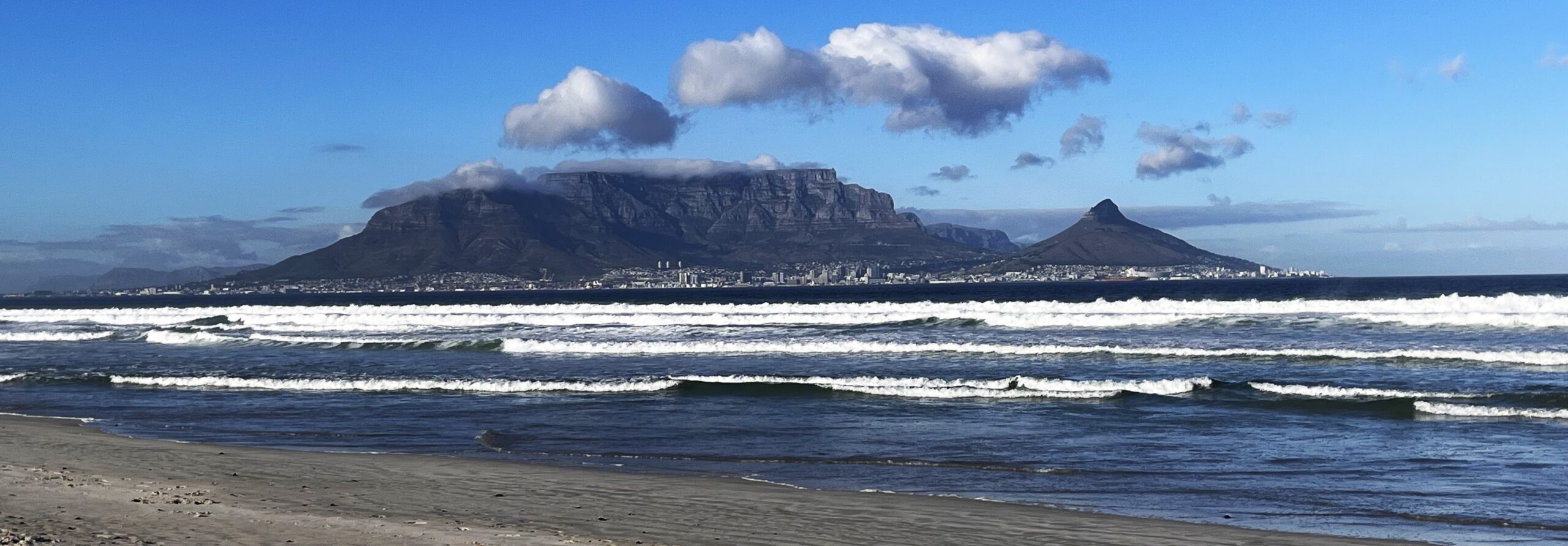
Geographically, I would say that Cape Town is a perfect city. Although it’s a major business hub, it also has some incredible nature, both forming part of the city and only a stone’s throw away.
Within the city there are some remarkable geological features, including Table Mountain, Lion’s Head and the Twelve Apostles mountains along the coastline going north to south. You’ve also got a choice of beaches, all with golden sand and inviting blue waves (although it’s likely to be cold!). Going south on the Cape Peninsula you’ve got wild seals and penguins, more arching sandy bays, and the Cape of Good Hope which is the meeting point of the Indian and Atlantic Oceans.
All in all, Cape Town is a place where all forms of nature spectacularly collide.

2. Racism is still extremely prevalent
On a less happy note, it’s worth being aware that racism is extremely prevalent in Cape Town.
You’ll probably be aware that South Africa has a turbulent history of racial tension resulting from colonisation. White European settlors forced South Africa’s black indigenous occupants into a subservient status over many decades. The unrest and rebellion that followed eventually culminated in apartheid.
The after-effects of apartheid supposedly included better racial equality written into South Africa’s laws. But this is not apparent visually in Cape Town or across South Africa. The white descendants of European settlors are very evidently still richer and more powerful than the black indigenous South Africans. For example, you walk into a restaurant and you can almost guarantee that all the waitstaff will be black and the manager is white. From this, I deduce that black people tend to be kept in lower-level jobs whilst white people are parachuted into management positions; there’s not a hint that you start at the bottom of the ladder and work your way up.
In the middle of all this you also have coloured people. They are the descendants of immigrants and slaves from largely South and South East Asian countries. They fall somewhere between the whites and the blacks in terms of hierarchy.
All of this leads to vast wealth inequality. The black community is the poorest group in Cape Town. They and the coloured communities live in ‘townships’, which are segregated sections of the city (I come back to townships below). In contrast, all of the luxury flats along the Clifton Beaches, overlooking the Atlantic Ocean and the Twelve Apostles, are surely owned by white people.

I am fully aware that as a white person I can’t possibly know or explain the nuances of racism, especially in a country such as South Africa which has such a complex and turbulent history of racial struggles, and where so much of its fundamental history is based on issues of race. All I can do is explain what I observed and recommend that you read some more about this issue in more detail before you go. I’d suggest the following books – the first two are fiction and the second two non-fiction:
- The Promise by Damon Galgut
- Frankie and Stankie by Barbara Trepido
- Born a Crime by Trevor Noah
- Long Walk to Freedom by Nelson Mandela
3. You can go on guided tours of townships
Staying on the subject of Cape Town’s wealth equality gulf, I was taken-aback to find that you can sign up for guided tours of the townships where many black and coloured people live. This, to me, is a blatant glorification of poverty and is incredibly patronising. How can it possibly be made into a spectacle for tourists in an ethical way?
The answer is that it can’t. I think this is the worst kind of tourism – this is people’s reality. I strongly recommend that you decline any opportunity to do a township tour.
4. Load shedding could return at any time
The long-term after-effects of apartheid include a government which is sadly riddled with corruption. Part of that corruption manifests itself in load shedding.
Load shedding is when all of the electricity across Cape Town (and more widely in South Africa) is turned off in order to save power. This largely resulted from corruption within the energy industry. For example, workers could be bribed to secrete coal away from the power plants and replace it with rocks, which breaks the machines that provide the power and leads to a shortage of resources.
As of early 2026, a number of months has gone by without any power blackouts. This is certainly an improvement on the previous few years when load shedding was a daily occurrence.
But experts have warned that restructuring in South Africa’s main electricity company could result in insufficient resources and might well lead to a return of load shedding.
You might not experience load shedding at all on your trip to Cape Town. But it’s best to be aware that it is a real possibility.

5. Your best meals will be from the least touristy restaurants
Let’s move on to a happier subject: food. This one sounds obvious but I’ll go into a bit more detail.
If you go to what is marketed as a “South African restaurant”, you might leave thinking it was rather overpriced. This seems obvious in retrospect – if I saw an “English restaurant” in England I’d know instantly that it was aimed at tourists and would avoid it without question. But, since I made the mistake, I’ll share my experience so that you don’t do the same.
When we went to a “South African restaurant” in Cape Town, we found ourselves paying about double the price of other restaurants we’d been to for our food, and the equivalent of about £25-30 for a bottle of South African wine. This doesn’t sound wildly expensive, but in comparison to the other restaurants we’d been to, where the equivalent wine cost less than half of that, it was pricey. Even with a restaurant markup, South African wine doesn’t have any duty on it so there’s no need to pay £30 (unless you have much finer taste than me).
My recommendation is to find a restaurant that looks innocuous as you can almost guarantee it won’t be on the tourists’ radar. One of my favourite meals in Cape Town was at Ocean Basket. This is a casual, almost fast-food outlet serving fish and seafood. It’s the kind of place where families eat and it doesn’t pretend to be something it isn’t. But the fish we ate there was absolutely delicious. Which brings me on to…
6. You have to try kingklip
…kingklip. Kingklip is a meaty, white fish native to the coastline running from Cape Town up to Walvis Bay in Namibia. It has the texture of tuna steak and it’s one of the most flavourful fish I’ve ever tasted, made even better by the fact that it’s fresh from the sea right at Cape Town.
(Technically kingklip is actually a type of eel rather than a fish. But hopefully my ravings about how delicious it is have eclipsed any hesitations you now have about eating eel. I’m usually quite a cautious eater but I promise you that you will not regret trying kingklip. Seriously.)
7. Cape Town has a thriving coffee culture
Staying on the subject of food and drink, I was surprised to find that Cape Town is a coffee hub. It has numerous quirky cafés where people conduct business meetings at tables out in the sum, or tap away on laptops.
The general standard of coffee is high – so high that even the coffee we bought at the SPAR down the road from where we stayed was of unexpectedly high quality.
The abundance of cafés in Cape Town means that you’re never going to be at a loss for somewhere to sit and rest for half an hour and watch the world go by.