If you’re thinking about a trip to Namibia, I’m going to hazard a guess that you’re a pretty intrepid traveller. Namibia has so much to offer and I can highly recommend a trip there! But before you go, here are five things you should know before you travel to Namibia.
1. Deserts can be more varied than you think
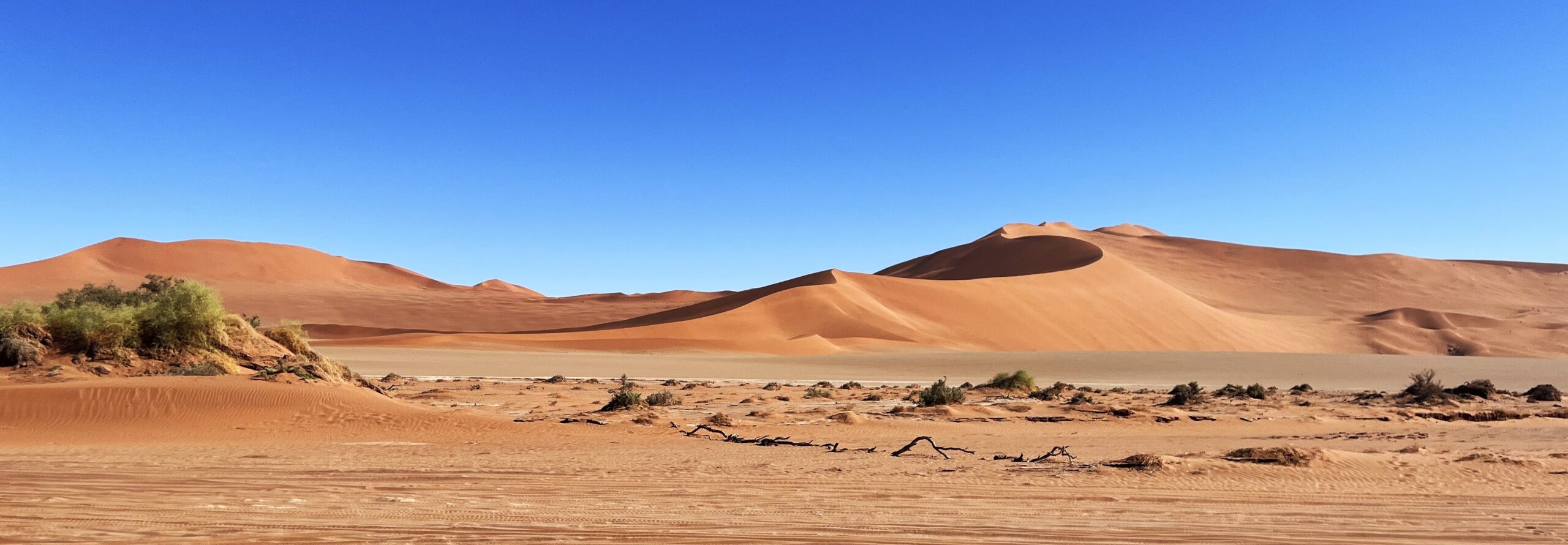
Namibia is mostly desert. Now this might sound boring at first, but Namibia opened my eyes to how varied desert landscapes can be.
Namibia has sand dunes, mud flats, salt flats, scrubby yellow plateaus, rocky mountainous areas – basically, I didn’t get tired of Namibia’s desert landscapes because there really is always something new to look at.

2. Namibia is very sparsely populated
Due to being mostly desert, Namibia is the second most sparsely populated country in the world, beaten only by Mongolia. It has a population of around 3 million, over an area of 824,000 square kilometres. To put that into perspective, that’s like spreading out the population of Wales across an area seven times the size of the United Kingdom.
Namibia’s sparse population means that settlements are few and far between. You can drive for literally hours and pass only a few other vehicles.
3. You should take tourist activities with a pinch of salt
Namibia is not on the traditional tourist map. If you express the desire to travel to Namibia, this is likely to generate some interest as it’s not your usual holiday destination.
The downside of the comparative lack of tourists in Namibia is that the tourist hubs can be touristy. For example, any tours from Swakopmund and Walvis Bay are surprisingly expensive. Walvis Bay is on the cruise ship route so it does get a higher concentration of tourists than other parts of Namibia. You might also have seen the dunes at Sossusvlei becoming popular on Instagram, with people apparently scrambling up a sand dune wearing a floaty dress and sandals (I would not recommend this).

In general, I had the sense Namibia is still figuring out how to handle tourists. Personally, as a tourist, I don’t like the assumption that I need to be entertained all the time, but I have found that many tourist activities in places which are just breaking into the tourist map, like Namibia, seem to be designed to prevent you at all costs from being bored.
For example, in Swakopmund you can go on a wildlife boat trip. This seems innocuous until it transpires that the boatmen entice wild animals onto or near the boat for the tourists’ entertainment. Aside from the obviously questionable ethics around this (and I didn’t do this boat trip for this reason), I do wonder why it seems to be assumed it would be too boring to do a boat trip and just look at the wildlife from afar.
My point is that I felt sometimes that the efforts to entertain tourists who travel to Namibia go too far, probably because the tourist industry there is still finding the right balance.
4. Namibia has a brutal colonial history
The fourth thing you should know before you travel to Namibia is that it has a brutal colonial history.
Namibia was colonised by Germany at the end of the nineteenth century. After some uprisings against the German colonisers by the Herero and Nama communities, the German authorities embarked on a genocide to rid Namibia of people of those ethnicities. Anybody who survived was subject to imprisonment or forced labour, and there followed a segregation between the local populations and the white settlers.
Germany has officially apologised for the Namibian genocide and is in the process of paying reparations of over €1 billion.
Today, Namibia has a number of ethnic groups, primarily the Khosian and Bantu peoples, each of which is made up of various sub-groups.
5. Namibia is very protective of its plants
Finally, on a lighter note, Namibia is very protective of its plants. At its Namibia’s borders, you’ll see signs warning you against stealing or damaging native plants, the sanction being prosecution. I arrived overland from South Africa and thought this was quite funny at first. But as I travelled through Namibia I realised that its plants really are something special.
In particular, look out for quiver trees. These are curiously structured as their leaves look rather like roots, making them look as though they are upside down. There’s a whole quiver tree forest near Keetmanshoop in southern Namibia, designated as a national monument in 1995.

You will also see snake plants everywhere. These are plants with tall, pointed leaves, with a lighter green border round each leaf. I have one as a houseplant at home, but the ones in Namibia outshine my houseplant a million times over. Namibia’s snake plants are bright greens, can be extremely tall and grow abundantly!
Namibia’s plants are all the more impressive by the fact that they have adapted to grow in the country’s desert landscapes. My verdict is that the plant protection measures are justified and the plant pride is more than deserved.
Leave a Reply