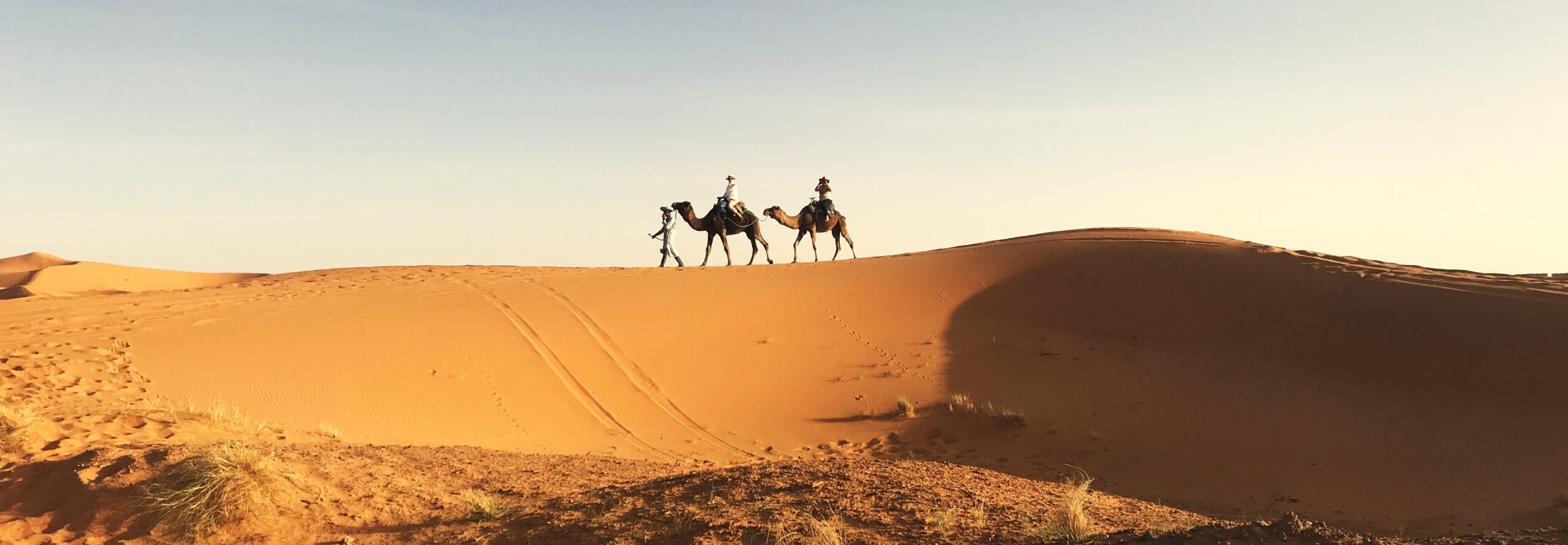
As part of my nine days in Morocco, I did a three-day tour to the Sahara Desert. It was a whistle-stop tour of traditional Bedouin villages, remote desert filming locations, a foray into the sand dunes – and camel riding in the Sahara.
I generally don’t love group tours but I think they serve their purpose. I was travelling solo, and Morocco can be quite a tricky place for a solo female traveller. I also really wanted to get out into the Sahara Desert and see the sand dunes, and I was happy to accept whatever other activities came with that on the tour.
In retrospect, I wish I had done more research about camel riding in the Sahara. But I digress – I’ll tell you about the tour first, and then give a few more thoughts on the camels at the end.

Getting lost in the medina
The tour to the Sahara Desert started and finished in Marrakesh. I met the minibus before dawn on a street corner in Marrakesh – although I nearly didn’t make it.
I was staying in Marrakesh’s medina, a maze of winding alleyways, almost impossible to navigate as a visitor. I arranged with my hotel for someone to guide me out in the morning to avoid getting lost. I arrived at reception to meet my guide at the appointed time and no one was there. Conscious that the bus would be waiting, I had no option but to find my own way out.
This was one of those travel moments where you feel sick with anxiety. It was dark and I was lost. I felt unsafe, and I was worried not only that I would miss the bus but also that someone might leap out of the darkness and harm me.
Fortunately, I rounded a corner and saw people returning home from morning prayers – despite the early-morning darkness, the medina wasn’t deserted after all. Then, to my relief, I suddenly managed to find my way out of the medina and onto the streets. I wasn’t far from where I was due to meet the bus. I spent a few more minutes worrying about standing on a street corner in Marrakesh by myself in the dark, but then the bus arrived and I boarded gladly.
Marrakesh to the Sahara Desert
After my early-morning emotional rollercoaster, I settled into the journey.
The distance from Marrakesh to the Sahara Desert is about 550 kilometres so we arrived there on the second night of the tour.
First, after travelling up winding roads into the Atlas Mountains, we reached Aït Benhaddou, a UNESCO World Heritage Site. Aït Benhaddou is an old fortified village whose buildings are constructed from earthen clay, colouring the whole village a reddish-brown. It was a key stop on the ancient Sahara trade route which extended to Timbuktu in Mali.

Aït Benhaddou has also been used as a filming location for all sorts of desert-based films, mostly set in ancient times. We also later passed through Ouazazarte, home to Atlas Studios, where we saw some of the film sets.
The next morning, we made a short stop at the Todra Gorge. This is a bubbling river with a natural spring, flowing between high red cliffs. We then continued down dry, desert roads towards the Sahara.
Erg Chebbi sand dunes
We reached the Erg Chebbi sand dunes in the Sahara Desert in the afternoon of the second day. This is everything you imagine in a desert: peaks of shifting sands stretching as far as you can see. Even the hundreds of sandy footsteps and wheel-marks are quickly smoothed by the desert breeze, returning the dunes to their untouched state.
Camel riding in the Sahara
This was where the camels came in. We had the option to ride in a caravan of camels for an hour or so, or to have a candlelit dinner in the desert. Of course, nearly everyone chose the camels. Only one couple chose the dinner (weird choice).
Riding a camel was a novel experience for me. You have to climb up into the saddle whilst the camel is lying down. Then, when it’s ready, it’ll stand up very suddenly, somehow straightening all four legs at once rather than scrambling up leg by leg as I had expected. I felt impossibly high up because the saddle is lined up with the top of the camel’s humps. Then the camel’s gait makes it a bumpy ride.
We rode around as the sun was setting, clutching the metal T-bar at the front of the saddle to stop ourselves jolting around too much. The shadows lengthened and the dunes began to turn rose-pink as the sun advanced towards the horizon. All I could hear was the breeze blowing gently and the camels’ footsteps thudding purposefully on the soft sand.
Riding a camel is not the most comfortable experience. But why pass up a classic opportunity to ride a camel in a desert?

Desert campfire
We ate dinner round a campfire and then the Bedouins entertained us with singing, dancing and drumming.
As an introvert, and as I was travelling solo, I felt a bit awkward as we were expected to participate. I also don’t love it when the “locals” put on a show for the tourists. Not only can it feel forced, but it also gives the impression that tourists need to be entertained at all times, instead of just being able to take in the wonder of the scenery around us. How could you need additional entertainment under a night sky in the Sahara Desert?
Anyway, I did manage to get away and climb a sand dune in the darkness. The sand was still warm and a thin crescent moon provided scant light. I felt miles away from anywhere.
We slept in sturdy tents hung with patterned Bedouin fabrics.
Back to Marrakesh
On the third day of the tour, we awoke early and scrambled up a sand dune to watch the sunrise. The sun’s rays crisscrossed the sky as it appeared on the horizon.

We set off to drive the 550 kilometres all the way back to Marrakesh, arriving in the early evening.
Verdict on the tour
Overall, I did enjoy the tour. It was amazing to see the sand dunes in the Sahara Desert, which had been my reason for joining the tour.
How much I enjoy tours also often depends on the group. I was the only solo traveller in the group and it included lots of couples, so there were times when I felt out of place. It was also a popular tour where numerous groups are doing the same route, so at times it felt crowded. I didn’t feel like I was getting a particularly unique experience, although I appreciate that’s often the trade-off for the ease of joining a ready-made tour.
Thoughts on animal tourism
To round off, I’ll give my thoughts on the ethics of the camel riding.
Animal tourism has been something that I’ve thought about more carefully as I’ve become a more experienced traveller, trying to do the right thing for the planet whilst still seeing it in the fullest way I can.
The problem with camel rides in the Sahara, and with animal tourism more generally, is that it’s your responsibility to scrutinise how the animals are treated. On the face of it, they often seem healthy and well-looked-after. But how do you know?

Frankly the camels in the Sahara Desert looked fine to me. To be honest, at the time I didn’t really think about it in any depth. I certainly didn’t see any violence or sharp words towards them. The Bedouins seemed to like them and treat them with care. And they’re in an environment they’re built for, rather than being kept in pens or somewhere that conflicts with their natural biology.
Another thing to consider is what the animals are doing for the humans interacting with them. In this case, I was riding a camel. Camels are built in a such a way that they can carry humans. They’ve been doing it for hundreds of years, travelling in caravans across desert scenes on the trading routes. So I don’t think camel riding in the Sahara is on a par with elephants in Thailand having to strain to carry tourists around when they’re simply not built for that.
Would I go camel riding in the Sahara again? I think I would. What I saw on this tour indicated that the camels are cared for properly, and it helps that camels are capable of carrying heavy loads anyway.
But it’s still worth being vigilant. However much you want that Instagram shot, I think there’s a moral obligation to put the welfare of the animals before your own wants.
Leave a Reply