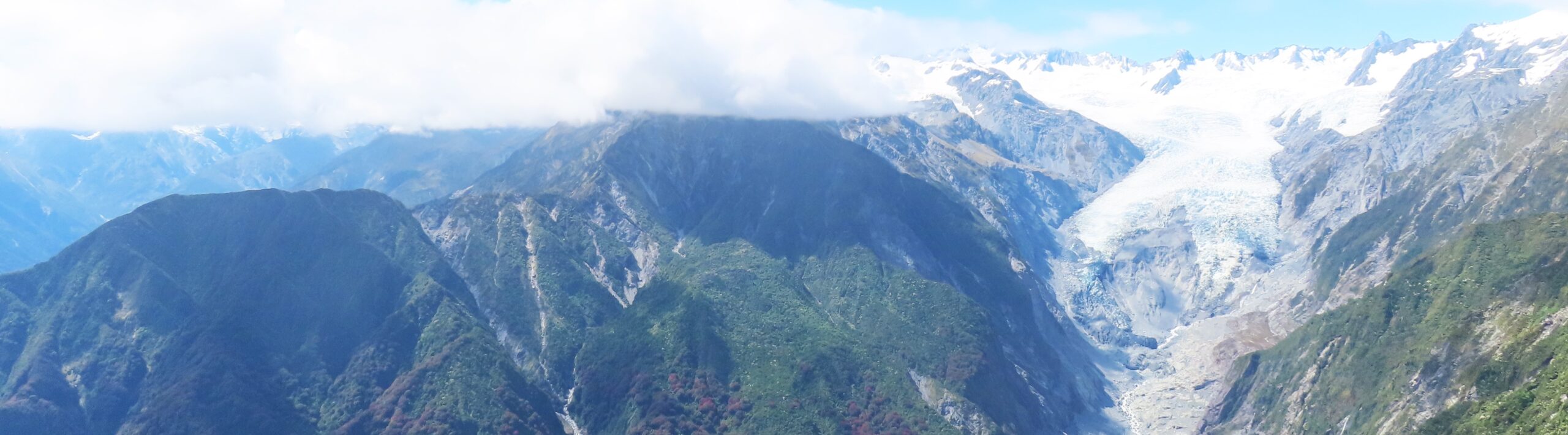
The Alex Knob Track is a mid-length out-and-back hike up to a stunning vista of New Zealand’s Franz Josef Glacier and the mountains and forests beyond it, all the way out to the coast. It’s a hard hike but it’s totally worth it. Here’s everything you need to know before you hike the Alex Knob Track.
Where is the Alex Knob Track?
The Alex Knob Track is about halfway down the west side of New Zealand’s South Island. The nearest town is Franz Josef/Waiau. We stayed in Fox Glacier which is about half an hour down the road from Franz Josef/Waiau. Here, you’re in between the Remarkables mountain range and the Tasman Sea.

How long is the Alex Knob Track?
The Alex Knob Track is about 10 miles. Essentially, it’s five miles up and five miles back down.
The hike took us around five hours, plus a rest at the top to admire the view and have a bite of lunch.
The advantages of getting there early
I advise getting to the hike relatively early. This is for two reasons.
First, because car parking near the trailhead is quite limited. Alternatively, you can park in Franz Josef/Waiau and walk 45 minutes to the trailhead. This way, you can also avoid paying the car parking fees that apply from December 2025 to June 2026.
Secondly, you have better chances of a good view of the glacier in the morning than the afternoon. From about lunchtime, there is a higher risk that clouds will obscure the glacier. We got to the summit at about midday, and we had a short window in which there were fantastic views across the forest-covered mountains before thicker cloud rolled in. To be honest, though, the weather here is pretty changeable – the glacier might be invisible one minute and crystal-clear the next! I’d say just try and get to the viewpoint during the morning and you should be OK.

How hard is the Alex Knob Track?
The Alex Knob Track is considered a hard hike and I would agree. Hiking five miles uphill is no mean feat, especially as the last stretch up to the top is the steepest. Total elevation over the course of the hike is around 3,600 feet (1,100m) – that’s more than Wales’ Yr Wyddfa (Snowdon)!
On the plus side, what goes up must come down, and the return downhill is not too taxing.
In terms of terrain, the path goes mostly through woodland and, although it’s generally well-marked, you might face obstacles such as fallen branches or short sections of climbing over rocks.

How busy is the hike?
When I did the Alex Knob Track, we only saw a few other groups of people. When we reached the viewpoint at the top, we shared it only with two others: a young man almost hidden in the grasses snapping photos of the glacier on a long-lens camera, and woman who seemed to have hiked all the way up wearing sandals and a skirt, apparently effortlessly as she was not out of breath in the slightest. She was on the lookout for samples of the native butterfly species and she also explained to us how far the glacier had receded in the last twenty years (a lot).
Wildlife along the Alex Knob Track
Speaking of butterflies, the Alex Knob Track is a wildlife hotspot so it would be remiss of me not to mention it. Numerous birds are native to this area, including the keruru (New Zealand wood pigeon and the kea (New Zealand’s national bird). Just listen out for them – you could make music from all of the different birdsongs on the Alex Knob Tracks.
What should you wear/bring to hike the Alex Knob Track?
In contrast to some of the other hikes I’ve written about, for the Alex Knob Track I do recommend you wear sports gear and proper walking boots. I wore cycling shorts and a sports vest.
I also recommend bringing something warm. It gets cold when you stop walking, especially at the viewpoint. After all, you are overlooking a glacier! I brought a long-sleeved thermal top and put it on when we sat and had our lunch.

I suggest also bringing:
- Suncream
- Insect repellent
- Plenty of water
- Snacks and/or lunch
- Camera
Final question: who is Alex Knob?
The Alex Knob Track is named after Alexander (Alec) Graham, a mountaineer and mountain guide who lived and worked in the Franz Josef/Waiau area in the late nineteenth and early twentieth century. Not only did he summit Mount Cook (New Zealand’s highest peak) thirteen times but he and his brother Peter are also credited with playing a significant part in getting New Zealand’s tourism industry up and running – they owned a hotel in Franz Josef/Waiau and led guided treks up to various mountain peaks in the area over many years.