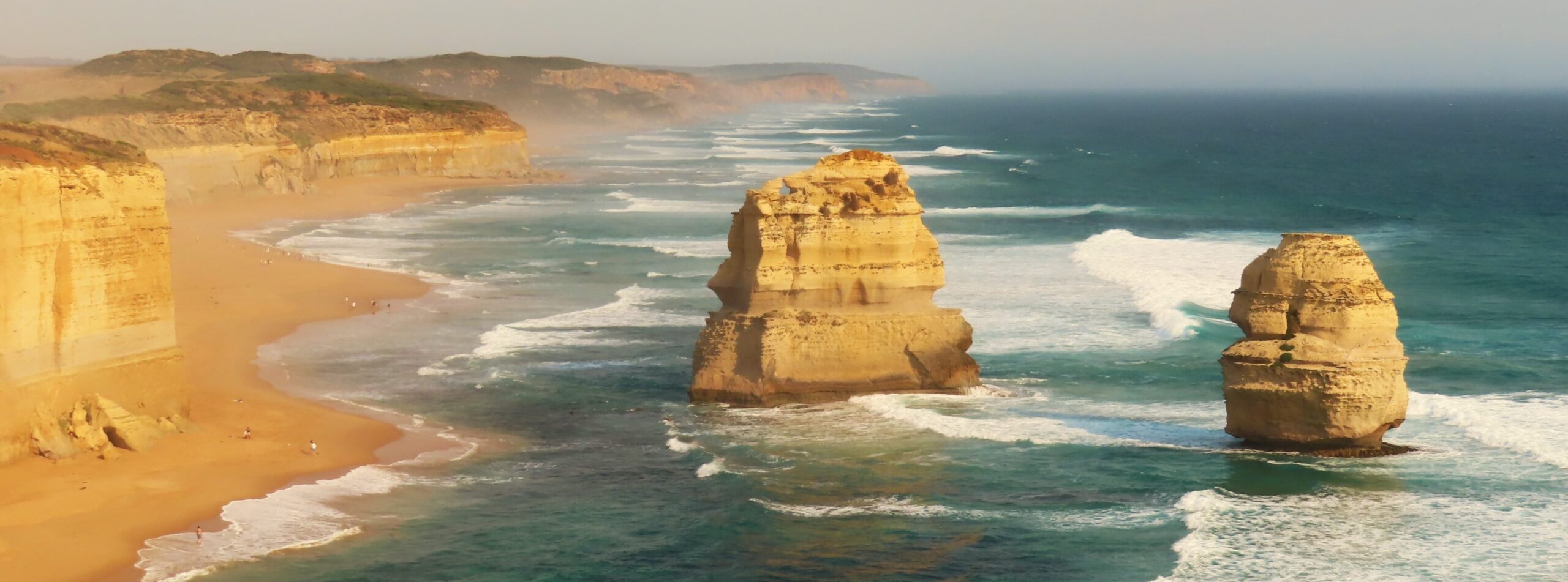
The Great Ocean Road, west of Melbourne, is renowned as a thing of beauty. It winds through small towns whose beaches are somehow more expansive than almost anything I’ve seen in the UK, through rainforest on the edge of Great Otway National Park, all the way to the spectacular Twelve Apostles. In short, this road trip is not to be missed if you’re in Melbourne. Here’s what you need to know before planning a Great Ocean Road trip.
How long do you need for a Great Ocean Road trip?
Two or three days is perfect. It’s about five hours’ drive from Melbourne to the Twelve Apostles (about 300km). So you can either drive there one day and back the next, or you can add a day to visit one or more of the Great Ocean Road’s beautiful beaches and/or drive down to Cape Otway. (See below for more on the Twelve Apostles and Cape Otway.)
If you’re limited on time, it’s possible to do a (very long) day trip to the Twelve Apostles from Melbourne. In this case, I’d recommend signing up for a tour. It would be a lot of driving in one day and it’s safer if someone who’s used to that route does the driving, as it’s a fairly tiring road to drive on (more below).
Of course, if you have more time, you could even spend a couple of weeks exploring the Great Ocean Road! I’ve suggested a few places below where you could stop and explore for a bit longer.
What is the Great Ocean Road like to drive?
Most of the Great Ocean Road is winding and fairly narrow, with one lane of traffic on each side of the road. The speed limit mostly varies between 80 and 100 kilometres per hour (approximately 50 to 65 miles per hour).

Anyone used to driving in rural New Zealand or the UK should be fine. Anyone used to driving on wide roads in a large vehicle should take extra care, particularly if you’re used to driving on the right. Australians drive on the left.
There is a lot of roadkill to avoid along the way, and signs warning you to watch out for kangaroos, but fortunately (or sadly?) we didn’t see any.
What to see along the Great Ocean Road
Most people’s aim in embarking on a Great Ocean Road trip is to see its crowning jewel: the Twelve Apostles. But there are also lots of other landmarks along the way. Here are some ideas of where to stop.
Geelong
Geelong is a small city about an hour’s drive from Melbourne. In fact, you hardly get out of Melbourne’s suburbs before you get to Geelong.
Geelong is an artsy place. It’s a UNESCO Creative City of Design and this is visible around the city in its mix of architectural styles. It’s got a vibrant waterfront complete with pier, Ferris wheel and a sweep of golden sand.
Further round the coast from Geelong is the Bellarine Peninsula. Here, you’ll find not only more picturesque beaches but also numerous wineries. If you’ve got longer for your Great Ocean Road trip, think about staying a night here so that you can enjoy all the wine you want!
Anglesea and/or Airey’s Inlet
Once you’re properly onto the Great Ocean Road, you start passing through smaller towns. Anglesea and Airey’s Inlet are examples of this, each with beautiful sandy beaches. They’re both nice places to stop for a snack or a quick sea swim.
Lorne
Continue on to Lorne. Lorne is bigger than Anglesea and Airey’s Inlet so it’s another option for a stop. Like Anglesea and Airey’s Inlet, it has stunning beaches. I’m sure if these beaches were in the UK they’d be a tourist hotspot, but Australia has so many incredible beaches that Lorne, Airey’s Inlet and Anglesea remain relatively unknown to outsiders!
Cape Otway and Great Otway National Park
The southernmost point of the Great Ocean Road is Cape Otway within Great Otway National Park. Much of Great Otway National Park comprises thick forest, and you’ll find many species of tree and several waterfalls among its branches. The national park also has a wild and dramatic coastline, dotted with empty coves at the foot of scraggy cliffs.
This is another place you could spend a bit more time if you have it. There are various campgrounds and also a famous eight-day hike you can do if you’re feeling sporty (more on this below).
Twelve Apostles
Next, this is what we’ve all come for: the Twelve Apostles themselves.
The Twelve Apostles is one of Victoria’s best landmarks. It’s a group of limestone rock stacks off the coast near Port Campbell. Due to erosion, there aren’t actually 12 now but there likely once were!
Park at the Twelve Apostles Visitor Centre and walk over the boardwalk to the viewing platform. The view that suddenly greets you is stunning. The gigantic sandy-orange stacks stand among shallow foamy waves washing onto a beach of untouched ochre sand. The sound of the splashing sea makes the scene yet more atmospheric and dramatic. It’s one of those places photos simply can’t do justice – you just have to see it for yourself.

Loch Ard Gorge
Just a few minutes down the road from the Twelve Apostles is Loch Ard Gorge. This is a rocky limestone gorge surrounding a beach of deep yellow sand. It’s named after a ship that was wrecked here in 1878 leaving only two survivors. There used to be a rock arch just off the coast but this collapsed in 2009. The stacks that remain are named Tom and Eva after the shipwreck survivors.
Port Campbell
Finally, arrive at Port Campbell. This is the nearest town to the Twelve Apostles. It has several places to stay overnight and a good variety of restaurants given its small size.
Back to Melbourne
If you’re heading back to Melbourne, you can either retrace your steps and call in at any of the above places you missed on the way out. Alternatively, you can take a quicker route inland, cutting off the Cape Otway peninsula.
Great Ocean Walk
If you’ve got time to spend on the Great Ocean Road, consider going the Great Ocean Walk. This is a 110km point-to-point hike from Apollo Bay (just east of Great Otway National Park) to the Twelve Apostles. Most people complete it over eight days. I’d love to do this one day – I can just imagine how stunning the scenery is along the way!
Where to next?
If you didn’t spend time in Melbourne before your Great Ocean Road trip, try and spend a few days there afterwards. Melbourne is Australia’s business hub so it has a busy corporate district, but it also has its fair share of parks and gardens. Queen Victoria Market is worth a visit, and Melbourne Cricket Ground is an essential stop for cricket fans. Melbourne also has a population of penguins which you can find on Phillip Island.
We had spent time in Melbourne before embarking on this road trip so, after returning from our overnight stop in Port Campbell, we caught a flight to Perth where we did a 10-day Western Australia road trip.
Alternatively, you can head up to Sydney – we had been there first and we caught the train between Sydney and Melbourne rather than flying.
If we could have made the car-hire logistics work, I would have loved to drive all the way along Australia’s almost-deserted south coast, round its southwest corner and up to Perth. By my calculations, this would have been at least a 10-day road trip including three or four stops. It’s just insanely expensive to drop a hire car off in a different place to where you picked it up! One to think about for next time…